FIFA World Cup Host Selection Process: Evolution Through the Years
Every four years, the globe unites to watch the greatest spectacle in sports. Yet, long before the first kickoff, an intense geopolitical and logistical battle takes place behind closed doors to win the hosting rights. Understanding the FIFA World Cup Host Selection Process: Evolution Through the Years reveals how football has transitioned from a modest amateur pastime into a multi-billion-dollar global industry. What once began as a simple handshake agreement among a handful of European and South American delegates is now a highly complex, audited, and technologically driven process involving hundreds of millions of dollars in infrastructure bidding.
For decades, the mechanics of choosing a host nation remained shrouded in mystery, often yielding unpredictable and controversial outcomes. However, as the economic footprint of the tournament expanded, so too did the necessity for a more rigorous and transparent system. In this comprehensive guide, we will trace this fascinating journey, showing how administrative reforms, financial motivations, and historical shifts have shaped the modern bidding landscape.
Table of Contents
- The Genesis of the FIFA World Cup Host Selection Process: Evolution Through the Years
- The Closed-Door Era: Executive Committee Hegemony
- The 2015 Corruption Reform: How Scandal Cleaned up the FIFA World Cup Host Selection Process: Evolution Through the Years
- The Modern Democratic Congress Vote Era
- The Evolving Bidding Criteria and Technical Requirements
- The Rise of Multi-Nation Joint Bids in the FIFA World Cup Host Selection Process: Evolution Through the Years
- Future Trajectory: 2030, 2034, and Beyond
- Historical Comparison of Selection Eras
- Frequently Asked Questions
The Genesis of the FIFA World Cup Host Selection Process: Evolution Through the Years
In the early days of international football, the bidding process was remarkably informal. When FIFA established the inaugural World Cup in 1930, the selection of the host country was decided during meetings of the FIFA Congress. Uruguay was chosen as the first host nation, largely because they were the reigning Olympic champions and offered to pay for all travel and accommodation costs of the participating teams.
Furthermore, Uruguay was celebrating its constitution’s centenary in 1930, making it a symbolic choice. However, travel in those days meant a grueling three-week boat journey for European teams, which led to a widespread boycott by major European football associations. Consequently, only four European nations crossed the Atlantic to participate. This logistical nightmare highlighted the urgent need for a more structured, balanced approach to selecting hosts.
To avoid future boycotts, FIFA attempted to alternate host duties between Europe and South America. In spite of this unofficial policy, controversy erupted when France was awarded the 1938 tournament, leading to a boycott by Argentina and Uruguay who felt the rotation agreement had been violated. Following World War II, FIFA solidified the alternation pattern to heal political divisions, laying the groundwork for what would become a highly standardized rotation system.
The Closed-Door Era: Executive Committee Hegemony
As the tournament grew in popularity during the mid-to-late 20th century, the voting power shifted from the general FIFA Congress to a smaller, elite group. Specifically, the responsibility of choosing the host nation fell on the shoulders of the FIFA Executive Committee (ExCo). This committee was a powerful circle consisting of just 24 high-ranking football executives.
On one hand, this change allowed for more rapid decision-making. On the other hand, it concentrated immense power in very few hands. Because the ExCo votes were cast via secret ballots, the entire selection process became highly susceptible to backroom lobbying, geopolitical deal-making, and financial influence.
This closed-door mechanism reached its absolute peak of controversy in December 2010. During a single, historic meeting, the ExCo simultaneously awarded the hosting rights for the 2018 World Cup to Russia and the 2022 World Cup to Qatar. The decision to award the tournament to Qatar, a tiny nation with limited existing football infrastructure and extreme summer heat, sparked widespread global criticism. This defining moment proved that the existing system was unsustainable and desperately needed an overhaul.
The 2015 Corruption Reform: How Scandal Cleaned up the FIFA World Cup Host Selection Process: Evolution Through the Years
Following years of mounting suspicion, the breaking point arrived in 2015. A massive investigation led by the United States Department of Justice exposed systemic corruption, racketeering, and bribery among senior FIFA officials. This scandal resulted in the arrest of multiple ExCo members and eventually forced the resignation of longtime FIFA President Sepp Blatter.
Consequently, the incoming leadership under Gianni Infantino realized that public trust could only be restored through radical structural reform. This led to a complete reconstruction of how the host nation is selected. The notorious Executive Committee was dissolved and replaced by the larger, more supervised FIFA Council.
Most importantly, the final power to select the host country was returned to the FIFA Congress. This meant that instead of just 24 executives making the decision behind closed doors, all 211 member associations would now cast an open, transparent vote. This shift marked a massive milestone in the FIFA World Cup Host Selection Process: Evolution Through the Years, steering the organization toward unprecedented levels of public accountability.
The Modern Democratic Congress Vote Era
The first major test of this newly reformed system occurred during the selection process for the 2026 tournament. In 2018, the 68th FIFA Congress convened in Moscow to vote on two competing bids: a joint bid by Canada, Mexico, and the United States, and a single bid from Morocco.
Unlike previous elections, the voting process was fully transparent. The votes of each individual member association were published online immediately after the ballot. This level of openness made it incredibly difficult for under-the-table financial deals to influence the outcome. The joint North American bid won with 134 votes to Morocco’s 65, proving that the new, democratic system could function successfully.
Under the current guidelines, the bidding process is divided into several rigorous stages:
- Submission of Expressed Interest: Member associations formally register their intent to bid with FIFA.
- Detailed Hosting Requirements: Bidders receive a comprehensive set of infrastructure, legal, and commercial standards.
- The Bid Book: Countries must submit highly detailed plans outlining exactly how they will meet these standards.
- Independent Evaluation: A specialized FIFA task force conducts on-site inspections and scores each bid on various technical parameters.
- The Congress Vote: The FIFA Council reviews the evaluations and puts forward the qualified bids to the FIFA Congress for a final, public vote.
The Evolving Bidding Criteria and Technical Requirements
Historically, hosting bids were won based on political promises and general prestige. Today, however, the technical demands of hosting a World Cup are incredibly strict. According to official guidelines on the official FIFA website, a country must prove it has the modern infrastructure required to handle millions of international visitors.
With the expansion of the tournament to 48 teams starting in 2026, the logistical burden has increased exponentially. Hosts are now subjected to a strict bidding criteria matrix that leaves very little room for error. Some of the core requirements include:
- Stadium Infrastructure: Host nations must provide at least 14 fully all-seater stadiums, with a minimum of 7 being pre-existing structures.
- Stadium Capacity: The opening match and the final must be played in stadiums with a capacity of at least 80,000 spectators. Semi-finals require a 60,000-seat capacity, while general group matches require at least 40,000 seats.
- Team and Referee Facilities: Bidders must secure at least 72 high-quality training site options for team base camps, alongside four dedicated training sites per stadium.
- Accommodation and Transport: Host cities must feature extensive hotel infrastructure and robust public transport systems capable of seamlessly moving massive crowds between venues.
- Human Rights: Under the reformed bidding process, candidates must submit detailed human rights strategies, promising to protect workers’ rights and adhere to international labor standards.
The Rise of Multi-Nation Joint Bids in the FIFA World Cup Host Selection Process: Evolution Through the Years
As the tournament’s physical scale and financial demands skyrocketed, a single-host format became practically impossible for most nations. Consequently, we have witnessed a massive shift toward multi-nation joint bids, which represents another crucial milestone in the FIFA World Cup Host Selection Process: Evolution Through the Years.
Historically, FIFA was highly skeptical of shared hosting duties. The first-ever joint bid occurred in 2002, when South Korea and Japan co-hosted the tournament. While the event was an on-field success, it was plagued by immense logistical friction, high travel costs, and complex diplomatic coordination. In the immediate aftermath, FIFA actually passed a statute officially banning future co-hosting bids.
However, the economic reality of the 48-team era forced FIFA to reverse this stance. Co-hosting is no longer just allowed; it is actively encouraged as a sustainable solution to prevent host nations from building expensive, underused “white elephant” stadiums. The 2026 tournament, hosted jointly by Canada, Mexico, and the United States, stands as a prime template for this modern approach. By sharing the immense financial and logistical burden, these nations can utilize existing world-class infrastructure without risking national debt.
Future Trajectory: 2030, 2034, and Beyond
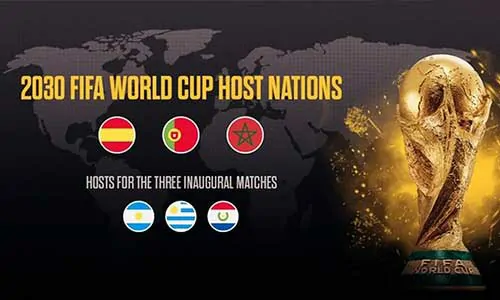
The future of the World Cup host selection continues to break historical barriers. The selection of the 2030 host nation has resulted in an unprecedented, multi-continental format. To celebrate the centenary of the first World Cup, the primary tournament will be co-hosted by Morocco, Portugal, and Spain, while three special celebratory opening matches will be played in Uruguay, Argentina, and Paraguay.
This creative, sprawling solution cleverly honors the tournament’s South American roots while placing the bulk of the modern logistical demands on the robust infrastructure of Europe and North Africa. Meanwhile, this multi-continental arrangement triggered FIFA’s strict continental rotation policy, which dictates that confederations hosting the previous two tournaments cannot bid for the next one.
As a result of this rotation policy, both UEFA, CAF, and CONMEBOL were ruled ineligible to bid for the 2034 edition. This opened a direct path for the Asian Football Confederation (AFC) and Oceania, ultimately leading to Saudi Arabia emerging as the sole bidder and being confirmed as the host for the 2034 tournament. This highlights how strategic administrative rules can heavily shape the competitive landscape of the bidding process.
Historical Comparison of Selection Eras
To clearly visualize how the selection process has changed, let us compare the key features of the primary eras in FIFA’s history:
| Historical Era | Decision-Making Body | Voting Transparency | Primary Selection Criteria | Multi-Nation Policy |
|---|---|---|---|---|
| Early Era (1930–1954) | FIFA Congress Consensus | Low (Informal meetings) | Diplomatic lobbying & financial guarantees | Strictly prohibited |
| ExCo Era (1958–2010) | Executive Committee (24 members) | None (Secret balloting) | Geopolitical influence & commercial potential | Discouraged (Except 2002) |
| Modern Era (2018–Present) | Full FIFA Congress (211 members) | High (Publicly recorded votes) | Strict technical scores & human rights audits | Actively encouraged |
This structural evolution demonstrates that while the process is not entirely free from geopolitical maneuvering, it has become undeniably more transparent, democratic, and structurally sound than at any other point in football history.
Conclusion
The journey of the World Cup from a localized tournament into a massive global phenomenon has forced FIFA to radically modernize its administrative procedures. As we have seen, the FIFA World Cup Host Selection Process: Evolution Through the Years has moved away from highly exclusive, secretive committee decisions toward a highly transparent, fully democratic voting system involving all 211 member nations. With the ongoing rise of sustainable multi-nation bids, the tournament is poised to continue expanding its global footprint while minimizing financial risks for host countries.
If you want to keep up with the latest developments in international football administration, historical records, and tournament statistics, make sure to explore the comprehensive List of FIFA World Cup hosts. What are your thoughts on multi-nation hosting? Let us know in the comments below, and don’t forget to share this article with your fellow football enthusiasts!
Frequently Asked Questions
1. How was the host of the first FIFA World Cup selected?
The host of the inaugural 1930 World Cup was chosen by the FIFA Congress during a meeting in Barcelona. Uruguay was selected because they were the reigning Olympic champions and offered to cover all travel and accommodation expenses for the participating teams.
2. Why did FIFA change the voting process from the Executive Committee to the Congress?
Following a massive corruption scandal in 2015, which revealed widespread bribery and vote-selling within the 24-member Executive Committee, FIFA decided to reform the process. By giving the voting rights to all 211 member nations in the FIFA Congress, they established a much more transparent and democratic system.
3. What is the continental rotation policy in the bidding process?
The continental rotation policy dictates that member nations belonging to a confederation that hosted either of the previous two World Cups are prohibited from bidding for the next edition. This rule ensures that the tournament rotates fairly across different continents over time.
4. Why is co-hosting becoming the standard for modern World Cups?
Since the tournament has expanded to 48 teams, the logistical and financial burdens of hosting have grown immensely. Co-hosting allows countries to share the massive infrastructure costs, utilize existing world-class stadiums, and prevent the construction of expensive, underused facilities.
5. What are the minimum stadium requirements to host a World Cup?
Host nations are currently required to have at least 14 modern, all-seater stadiums, with at least 7 being pre-existing. The opening match and final must be held in a stadium with an 80,000-seat capacity, the semi-finals require a 60,000-seat capacity, and all other matches require a minimum of 40,000 seats.
6. How are the hosts for the 2030 and 2034 World Cups structured?
The 2030 tournament will feature an unprecedented format, with Spain, Portugal, and Morocco serving as the primary hosts, while Uruguay, Argentina, and Paraguay host three centenary matches. The 2034 tournament will be hosted solely by Saudi Arabia, which emerged as the only eligible bidder after the rotation rules restricted other confederations from bidding.